
以下は、2024年8月1日の広島大学で開催されるSalamander Meetingでの発表要旨です。
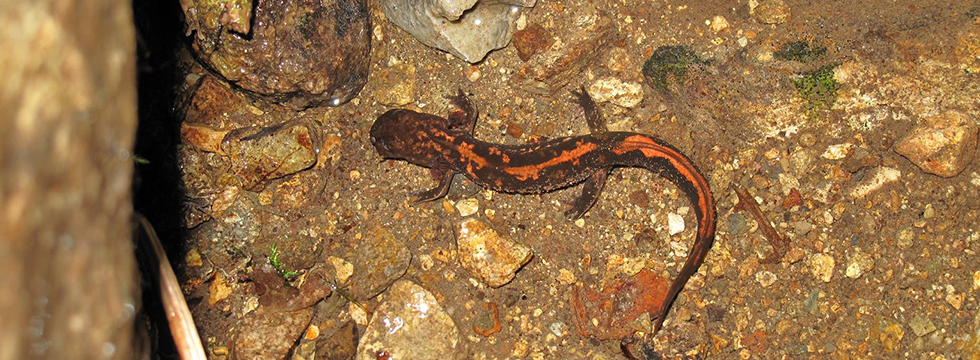
Cynops is a genus of newts, with 11 species living in China and 2 species in Japan. In Japan, the red-bellied newts (Cynops Pyrrhogaster), and the Sword-tail newts(Cynops Ensicauda), live as members of the Cynops.
Until now, the breeding season of the red-bellied newts was thought to be the same as that of many amphibians, beginning in spring and ending in early summer.
However, previous research have shown that the mating behavior of red-bellied newts occurs not only during spring and summer, but also in fall . Therefore, we decided to examine the reproductive ecology of the sword-tailed newts and compare it to that of the red-bellied newts in order to understand the significance of the newts special two-fold reproductive ecology in fall and spring.
Since the sword-tailed newts shares a reproductive ecology and is genetically similar to a species from southern China, which is believed to be the origin of the newts genus, we attempted to determine the breeding season by examining changes in weight of the reproductive organs and tissues of the newts over a one-year period. The results showed that while there is a gap between the breeding and spawning seasons in red-bellied newts, the breeding and spawning seasons in sword-tailed newts almost coincide with each other, from December to March. Considering that the breeding season of the sword-tailed newts is the basis of the entire newts genus, it is likely that many other southern Chinese species also have the same reproductive ecology, in which they take part in gametogenic behavior and then lay eggs consecutively.
We thus conclude that the reproductive ecology of the red-bellied newts, which initiates autumn gametogenesis but stops it once and then resumes gametogenesis and spawning in spring, was acquired because it is a species living at the low-temperature northern limit of the newts genus.