--The Concept and Development of an SSH Project Centered on the Caudata Research Institute--
"Hub-Based Open Lab Education" is not simply a system for establishing an advanced research laboratory within a school to support students' research projects. Its essence lies in transforming the school from merely a "place where knowledge is taught" into a place where questions arise, research continues, people connect, and new knowledge is created.
The ultimate goal is not the research outcomes themselves. What I seek to achieve through this educational program is an education grounded in the belief that "people become free by having questions of their own."
0. The Concept Did Not Begin with the Caudata Research Institute
First, I would like to make clear that the concept of Hub-Based Open Lab Education was not suddenly conceived after the establishment of the Yamawaki Caudata Research Institute. Looking back over my educational practice, I can see that its prototype had already emerged much earlier.
At Seishin Girls' High School, we sought to provide an education that went beyond simply transmitting knowledge in the classroom. Through the "Life" course, forest fieldwork, overseas programs, Scientific English, the Life Science Course, student research projects, collaboration with university researchers, and presentations at academic conferences, we sought to give students opportunities to encounter nature and living organisms directly and to develop their own questions from those encounters.
When the Super Science High School (SSH) program began at the school in 2006, we reorganized these existing educational activities into a science education program centered on student research. We also developed a system that connected students' research not only within the school but also with external research communities, including universities, research institutions, and academic societies.
Later, at Minami Kyushu University, we implemented the "High School Open Lab" program, which opened the university's research environment to high school students. The aim was to support research that could not be adequately pursued with high school facilities or teachers' expertise alone by bringing together university researchers, undergraduate and graduate students, and high school teachers.
Furthermore, through my involvement in the MSEC initiative, which sought to connect high schools and universities, as well as schools and local communities, in a network, I began to consider whether schools themselves could serve as points of connection among people and research institutions, rather than simply sending high school students to universities.
Building on these experiences, the SSH initiative at Yamawaki Gakuen began to take shape in 2022, followed by the establishment of the Yamawaki Caudata Research Institute in 2023. With the Institute at its core, we developed an educational program linking research, university collaboration, fieldwork, international exchange, research ethics, and research exchange among schools. This program was submitted as an SSH project and was approved in 2024.
Thus, the Hub-Based Open Lab Education now being developed is not a name retrospectively attached to a collection of separate activities.
Rather, it is an attempt to transform into a system of school education the educational philosophy that has gradually taken shape through my work at Seishin Girls' High School, the SSH program, the High School Open Lab at Minami Kyushu University, collaboration with universities and research institutions, and, finally, the Yamawaki Caudata Research Institute.
Without an understanding of this history, overseas programs, university collaborations, the High School Amphibian Summit, and the Caudata Research Institute may appear to be separate "events." My aim, however, is not simply to increase the number of such activities.
My aim is to connect them so that students' questions can lead them beyond the school to people, knowledge, places, and systems that enable those questions to develop.
1. The Starting Point Is Not "Training Students to Conduct Research"
When we speak of "research education" in schools, it is often understood as the enhancement of student research projects: students choose a topic, conduct experiments, analyze data, and present their work at competitions or conferences. In this sense, SSH programs are sometimes understood primarily as efforts to create schools in which students can conduct advanced research.
However, when I look back at the Life Science Course, forest fieldwork, overseas programs, the "Life" course, Scientific English, student research projects, and academic conference presentations that I developed at Seishin Girls' High School, I see something that they all had in common. Before teaching students how to conduct research, we first sought to expose them directly to the world.
Observing living organisms.
entering a forest.
Raising animals.
Traveling abroad.
Talking with researchers.
Encountering phenomena that do not conform to expectations.
It is through such experiences that a sense of surprise or unease arises within students:
"Why?"
"What is this?"
"I want to know more."
Research begins there.
Research education, therefore, should not begin with teachers assigning research topics or requiring students to write research plans. What is needed first is an environment in which questions can arise.
This is the first defining characteristic of Hub-Based Open Lab Education.
2. From Observation to Institutions
Questions alone, however, are not enough to sustain research.
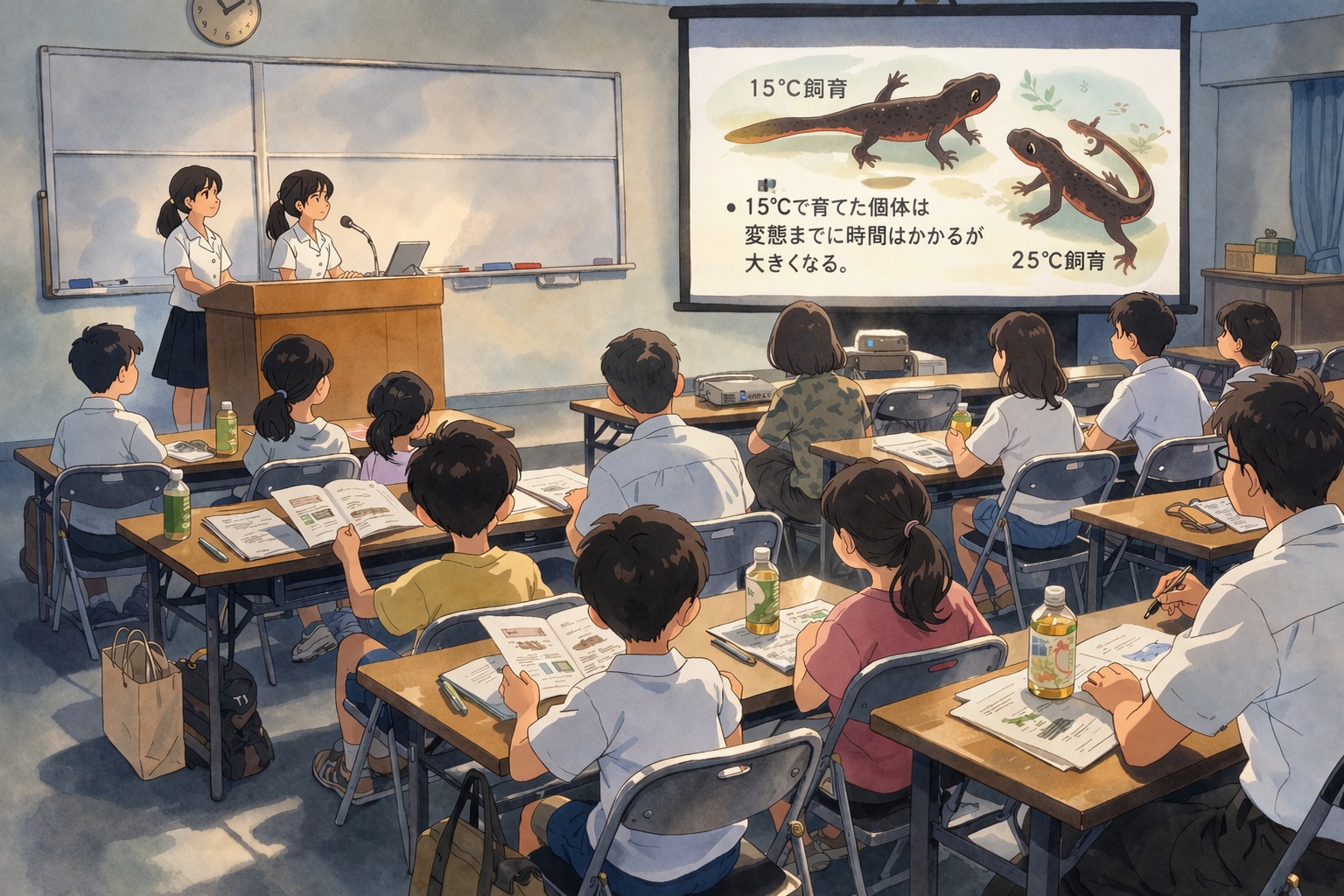
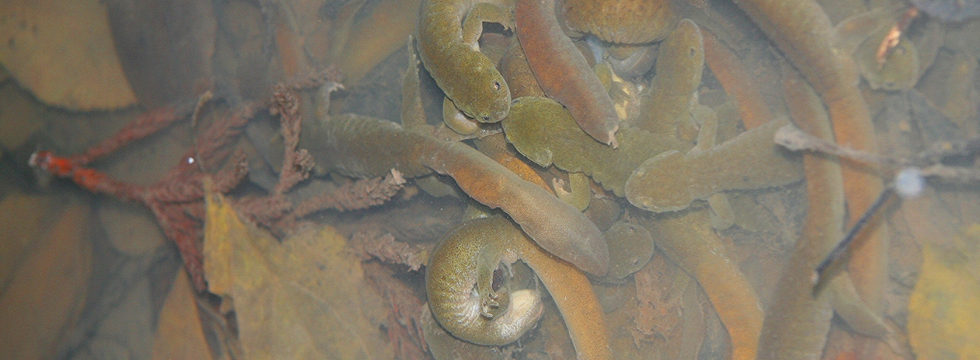
Suppose, for example, that a student observes newts and begins to ask:
"Why do they engage in courtship at this time of year?"
"How do females store sperm?"
"Does temperature affect their reproductive behavior?"
Turning such questions into research requires long-term animal care, continuous record-keeping, microscopy, tissue preparation, statistical analysis, literature searches, and advice from researchers.
Moreover, when living animals are involved, it is not enough simply to say, "I want to know, so I will conduct an experiment." A further question inevitably arises:
"Is it ethically acceptable to conduct this experiment?"
For this reason, I do not see the process as ending with:
observation → question → research
It must proceed further:
question → research environment → institutions
This is where the Caudata Research Institute becomes especially important.
Its laboratory, animal care facilities, research equipment, long-term records, networks of researchers, animal experimentation regulations, Animal Experiment Committee, university collaborations, and acceptance of students from other schools may appear at first to be merely the "facilities" and "systems" needed to conduct research.
I see them differently.
They are systems designed to prevent students' questions from being extinguished.
Even when a student has a genuine question, that question may disappear if a teacher responds:
"We cannot do that because we do not have the equipment."
"That is beyond what can be done in a school."
"That is too difficult for a high school student."
We therefore create research facilities.
We connect students with universities and researchers.
We establish the necessary systems.
This is not simply the development of research facilities. It is the institutional design required to keep questions alive.
3. The Meaning of the "Open Lab"
The High School Open Lab that I developed at Minami Kyushu University became an important prototype for the present Hub-Based Open Lab Education model.
University laboratories are normally spaces for undergraduate students, graduate students, and researchers. The Open Lab opened that research environment to high school students as well.
This made it possible for high school students to pursue research that would have been difficult with the equipment and human resources available at their schools alone.
But, in my view, the Open Lab had another important meaning.
It was not simply a system for sending high school students to a university.
High school teachers also participated in the research, supported students as partners, and shared their research questions. High school students, high school teachers, undergraduate students, graduate students, and university professors and researchers thus came together in the same research space.
In such a setting, high school teachers are no longer expected to be people who "know everything." They, too, learn from researchers. University students may become involved in research initiated by high school students. At the same time, a high school student who has observed a particular organism over a long period may know more about its behavior than anyone else present and may even explain those observations to a university researcher.
In this situation, the fixed relationship between "teacher" and "student" begins to dissolve.
Relationships are no longer determined solely by knowledge, age, or institutional affiliation. Instead, they are reorganized around the question being pursued.
This has profound implications for how we think about school education itself.
4. What Is the "Hub-Based" Model?
The Yamawaki Caudata Research Institute takes the idea of the Open Lab at Minami Kyushu University one step further.
Rather than having high school students simply visit universities, the aim is to make the high school itself a hub for research and education.
This is what I mean by the "hub-based" model.
Here, the word "hub" does not mean a central control center that manages students and teachers. In fact, it means almost the opposite.
Instead of confining education within a single school, the school connects universities, research institutions, other schools, local communities, and overseas institutions as a network, enabling them collectively to function as an educational environment surrounding the students.
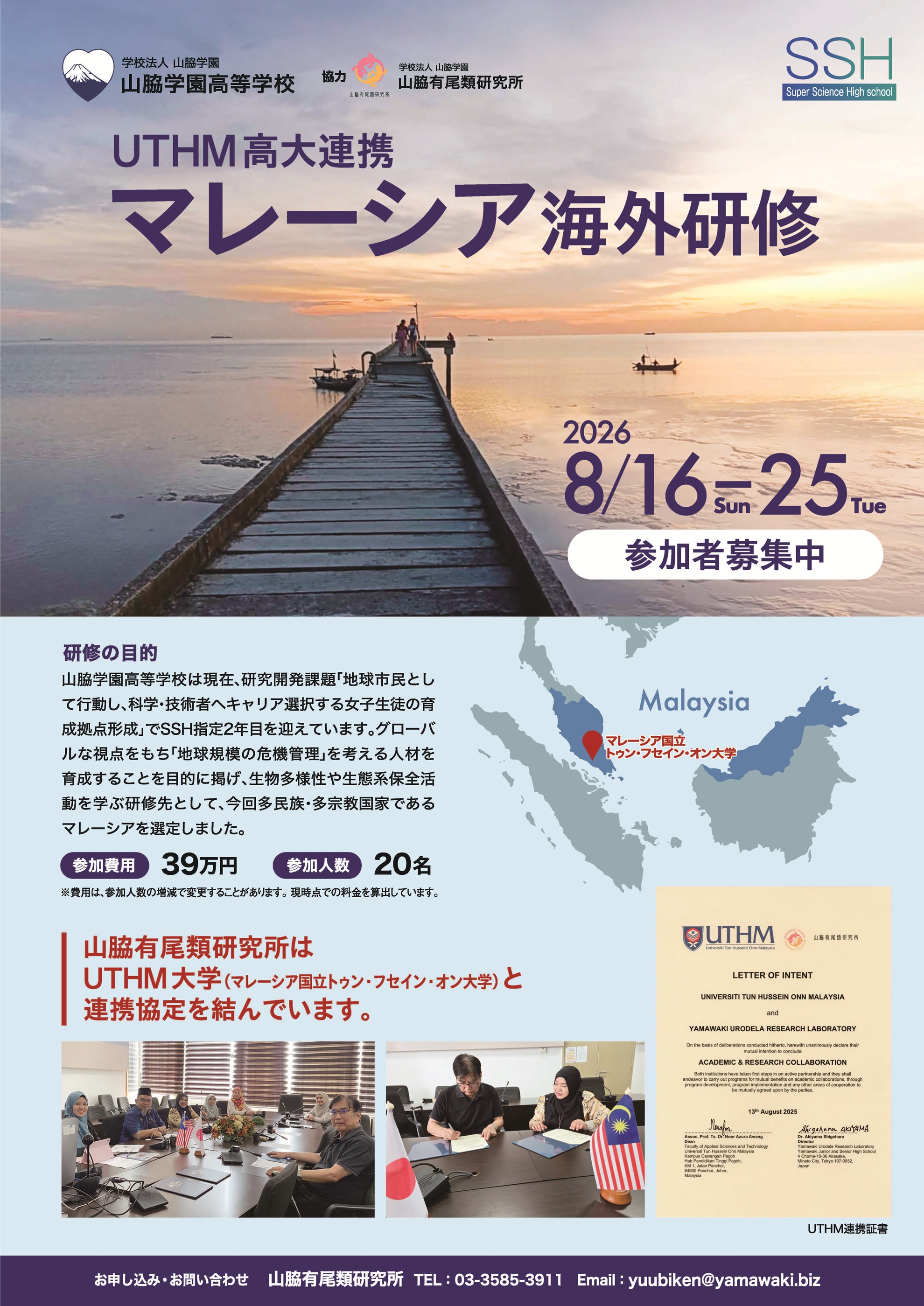
The current SSH program involves collaboration with university researchers serving on the SSH Steering Committee, as well as with Tokyo Jikei University School of Medicine, Tottori University, Tokyo Metropolitan Forest, high schools participating in the High School Amphibian Summit, the University of the Philippines, and UTHM in Malaysia.
These are not independent projects.
We are developing the entire SSH program as a Hub-Based Open Lab Education system by connecting university collaboration, forest fieldwork, international programs, exchanges among high schools, and advice from researchers.
A useful analogy is an airport hub. People arrive from many different directions, meet at the hub, and then depart in different directions.
In a similar way, the Caudata Research Institute connects university researchers, high school students from other schools, high school teachers, university students, local residents, people involved in conservation activities, current students, and alumni.
The important point is that the Institute is not the "pinnacle" of this structure.
It is a point of connection.
The essence of Hub-Based Open Lab Education lies in the coexistence of centrality and decentralization.
Physically, the Institute serves as a center. But it is not a center of power.
Who or what occupies the center changes according to the question.
In a histological study of newts, for example, a university researcher may become the center of technical expertise. When discussing the behavior of animals that have been kept at the school for many years, students may possess the most detailed knowledge. In field research, local people may have the richest understanding of the environment.
In other words, the aim is to create a research community in which the center shifts according to the question, rather than remaining fixed within a hierarchical structure.
5. The Crucial Difference from Research Conducted Entirely within a School
Research projects conducted entirely within a school tend to form a closed structure:
student → supervising teacher → school
The possibilities for research therefore depend heavily on the expertise and experience of the supervising teacher.
If students develop a research topic outside the teacher's field of expertise, adequate guidance may not be available.
If a teacher is transferred, the research may be interrupted.
If the necessary equipment is unavailable, the research may not be possible.
When students graduate, accumulated knowledge and techniques may disappear.
As a result, research becomes dependent on "that particular year, that particular teacher, and those particular students."
After many years of involvement with SSH, I have come to recognize these structural limitations of research conducted entirely within individual schools.
For this reason, Hub-Based Open Lab Education does not aim to create "a school in which teachers can teach everything."
Rather, it aims to create a school capable of connecting students with knowledge, people, and equipment beyond the school.
This represents a fundamental shift in thinking.
The goal is not to gather outstanding teachers in every possible field and complete all research within the school.
Instead, the school's ability to connect those who do not know with those who do becomes an educational capability in itself.
This also changes the role of teachers.
Teachers are no longer only "experts who provide answers."
They also become partners in research and coordinators who connect questions with people, knowledge, and expertise.
6. Caudates as Both Research Subjects and Mediators
Why caudates?
It is not simply because newts and salamanders are animals that I have studied for many years.
Caudates connect with a remarkable range of research fields, including development, reproduction, behavior, ecology, regeneration, environmental science, evolution, and conservation.
Even the study of newt reproduction can lead to questions in behavioral science, reproductive physiology, histology, endocrinology, thermal biology, seasonality, and habitat ecology.
Once students enter the field, their questions extend further into forests, ecosystems, environmental conservation, and local culture.
In other words, caudates provide a research subject through which one can begin with a single, concrete organism and gradually expand one's questions toward the wider world.
The Caudata Research Institute is therefore not simply "a school facility for studying newts and salamanders."
Through caudates as a medium, we connect education with research, research with conservation, schools with universities, high school students with researchers, Japan with other countries, and individual questions with broader social issues.
At first glance, the name "Caudata Research Institute" may appear to narrow the field to a highly specialized subject.
Paradoxically, however, pursuing one specific subject deeply can become a gateway to the wider world.
7. Research Ethics Is Not a Restriction but Part of Education Itself
In high school research, research ethics is often treated merely as a precaution added at the end of the process. It may remain at the level of statements such as "Treat animals with care" or "Follow ethical guidelines."
At the Caudata Research Institute, however, we have established animal experimentation regulations and institutionalized an Animal Experiment Committee that includes external researchers.
This was not done simply in response to ISEF requirements.
Rather, the purpose is to enable high school students themselves to confront a fundamental issue in science:
Having a question does not mean that one is free to do anything in order to answer it.
The desire to know inevitably encounters another question:
To what extent is it permissible to manipulate living organisms in pursuit of knowledge?
At this point, research becomes more than the acquisition of technical skills. It becomes education in the fullest sense.
Our addition of Respect to the 3Rs is an extension of this idea.
Living organisms are not merely materials to be used for research.
The freedom to conduct research carries with it responsibility toward life.
In this sense, research ethics does not exist simply to restrict freedom. Rather, by accepting responsibility, researchers establish the conditions under which research can be conducted freely.
8. Liberating Research from an Outcome-Driven Approach
Hub-Based Open Lab Education is also closely connected with the question of evaluation.
Within SSH programs and science competitions, attention can easily shift toward external outcomes:
"Did the student win an award?"
"Was the research published?"
"Was the presentation highly evaluated?"
"Did it help the student gain admission to a university?"
I myself have supported student research that has achieved high-level results, including participation in JSEC and ISEF.
Yet, through many years of practice, I have come to the conclusion that winning awards must not become the educational objective itself.
What matters most in research is the internal question:
"Why do I want to know this?"
When external evaluation becomes too powerful, students may begin to choose research that is likely to be highly evaluated, research that is likely to win awards, or research that their teachers want them to conduct.
At that point, research ceases to be an activity connected with freedom and once again becomes subordinate to external evaluation.
Hub-Based Open Lab Education therefore values not only research outcomes but also the process itself: asking questions, continuing to investigate, engaging in trial and error, entering into dialogue, deepening questions, and making ethical judgments.
This is directly connected with another question that I have continued to ask:
"Does evaluation make people free?"
9. Creating a Place Where Failure Is Acceptable
Another crucial educational value of Hub-Based Open Lab Education is the creation of a place where failure can be accepted.
In actual research, things often do not proceed as expected.
Mating does not occur.
Eggs are not laid.
The data are inconsistent.
A hypothesis turns out to be wrong.
Specimen preparation fails.
A discussion with a researcher reveals that the original hypothesis itself was mistaken.
School education does not always find it easy to deal with this kind of "not knowing."
Lessons have timetables.
Curricula have units.
Questions often have predetermined answers.
Students are evaluated.
Research, however, is by its nature open-ended.
Creating a research laboratory within a school therefore also means institutionally securing time in which answers are not yet known.
Learning to live with uncertainty.
Thinking for oneself.
Continuing to observe after failure.
Revising a hypothesis.
Asking others when one does not know.
Trying again.
I believe that these are among the most important attitudes science education should cultivate.
10. From Individual Expertise to Institutions
Another important issue is continuity.
An outstanding teacher may nurture many students.
But if everything depends on that one teacher, the practice may disappear when that teacher retires or leaves the school.
Through my long involvement with SSH at Seishin Girls' High School, the High School Open Lab at Minami Kyushu University, and subsequently the Caudata Research Institute at Yamawaki Gakuen, I gradually came to recognize a major challenge.
The issue was no longer simply how to create excellent educational practice.
The question became:
How can educational practice survive beyond the individual teacher who created it?
For this reason, the Institute requires not only research equipment but also regulations, committees, research records, university partnerships, human networks, accumulated research themes, animal breeding and care systems, and a research culture.
The Caudata Research Institute is therefore a research facility, but it is also an attempt to transform educational practice from something dependent on individual expertise into something sustained by institutions.
11. Institutionalization, However, Is Not the Goal
At the same time, I do not believe that "strengthening institutions automatically improves education."
If the institution itself becomes the goal, it may begin to control people.
My view is the opposite.
Institutions exist to protect questions.
Ethical systems exist to protect life.
The research institute exists to sustain and transmit research.
The hub exists to connect people.
Institutions, therefore, should not exist to control people. They should exist to support the questions and freedom of each individual.
This is where the progression from observation to institutions, and from institutions to freedom begins.
12. Seven Principles of Hub-Based Open Lab Education
The Hub-Based Open Lab Education that I envision can be summarized in seven principles.
1. The Principle of Questioning
Rather than imposing research topics from above, create environments in which students can develop questions of their own through observation and experience.
2. The Principle of Openness
Do not confine education and research within the school. Open them to universities, research institutions, other schools, local communities, and the wider world.
3. The Principle of Relationships
Avoid rigid hierarchical relationships among teachers, students, and researchers. Create relationships in which roles and centers of expertise shift according to the question being pursued.
4. The Principle of Continuity
Accumulate records, equipment, breeding and research systems, research themes, and human networks so that research does not disappear when students graduate or teachers are transferred.
5. The Principle of Ethics
In research involving living organisms, learn simultaneously about the freedom to know and the responsibility that accompanies that freedom.
6. The Principle of Valuing Process, Not Only Outcomes
Do not value research only in terms of awards or successful results. Recognize trial and error, failure, continuity, dialogue, and the deepening of questions as essential values of research.
7. The Principle of Freedom
The ultimate goal is not merely to produce outstanding researchers, but to cultivate people who can engage with the world through questions of their own.
These seven principles do not exist independently.
They are interconnected and together form a single educational system.
That system is what I call Hub-Based Open Lab Education.
13. "Open Lab" and "Hub-Based" Do Not Mean the Same Thing
"Open Lab" and "Hub-Based" are not redundant expressions for the same idea.
An Open Lab is about opening.
Opening the research environment.
Opening access to equipment.
Opening relationships with researchers.
Opening the school to the outside world.
Opening possibilities for research topics.
A Hub-Based model, by contrast, is about connecting.
Connecting people.
Connecting schools and universities.
Connecting research and society.
Connecting research in Japan with research overseas.
Connecting research from the past with the next generation.
Thus, "Open Lab" can be understood in terms of openness, and "Hub-Based" in terms of connection.
Bringing these two elements together creates:
an educational system in which people, knowledge, and questions continue to connect within an open research environment.
14. The Relationship with SSH: Transforming Individual Projects into a System
In this sense, Hub-Based Open Lab Education can be regarded as one possible advanced development of SSH.
One of SSH's great achievements has been to bring authentic research into high school education.
However, the longer an SSH program continues, the more likely certain problems are to emerge:
SSH may become an activity limited to a small group of staff members.
The program may falter when particular teachers leave.
Participation in presentations and competitions may become an end in itself.
Student research may become confined to a single subject or class within the curriculum.
I want instead to embed a research culture within the educational structure of the school itself, rather than allowing SSH to remain an event or the activity of only a few teachers.
This is why, in Yamawaki Gakuen's SSH application, we positioned the Caudata Research Institute not as an independent research facility, but as the core of the educational program.
The current activities--student research projects; collaboration with the Caudata Research Institute and university researchers; ethical review by the Animal Experiment Committee; fieldwork in collaboration with Tokyo Metropolitan Forest and Tottori University; international programs conducted with overseas universities; the High School Amphibian Summit; research exchange and support involving other schools; and connections with external research communities such as JSEC and ISEF--are not, in themselves, separate activities.
Their significance lies in connecting them into a single educational system.
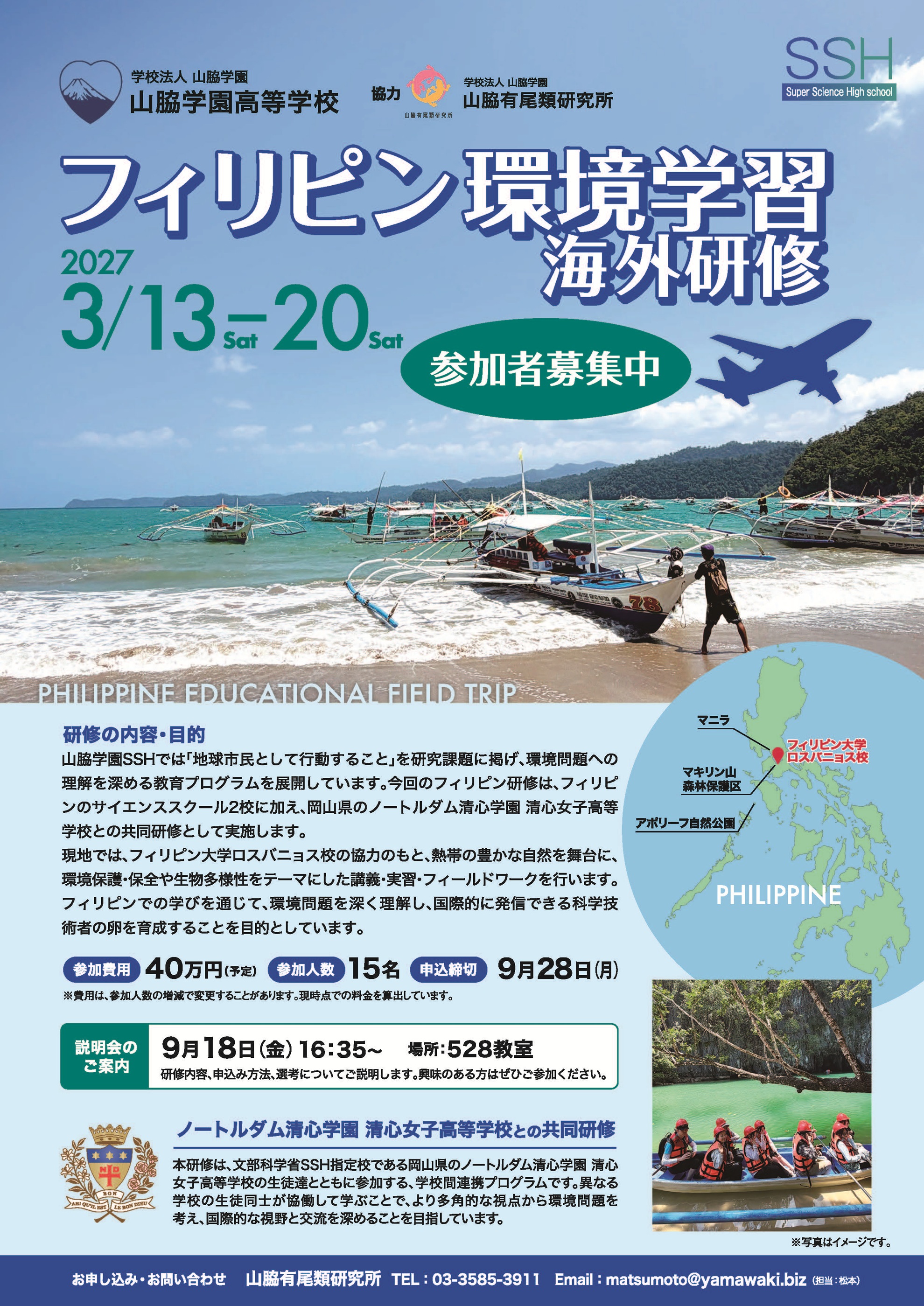
An overseas program, for example, is not valuable simply because students travel abroad.
Its educational meaning lies in enabling students to observe unfamiliar natural environments, encounter different cultures and researchers, and discover questions they had never previously considered.
It is therefore part of education that generates questions.
Collaboration with Tottori University is not simply an opportunity to show high school students what university research looks like.
Its significance lies in connecting questions that arise at school with a university research environment, researchers, and field sites.
It is therefore an essential component of Hub-Based Open Lab Education.
The High School Amphibian Summit is not simply a venue for research presentations.
It is an attempt to create a research community in which high school students and teachers from different schools can meet and share not only research results, but also breeding techniques, difficulties encountered in research, questions, and failures.
In other words, the full meaning of Hub-Based Open Lab Education cannot be understood by looking only at the outcomes of individual activities.
The more important question is:
How can university collaboration, overseas programs, fieldwork, research exchange, research ethics, and student research be connected so that they collectively support the inquiry of an individual student?
It is precisely this structure of connection that we are seeking to develop through the current SSH project.
15. From "Educating the Students of One School" to "A Community That Shares Questions"
Even more fundamentally, Hub-Based Open Lab Education requires us to reconsider the unit within which education takes place.
School education is ordinarily organized for the students enrolled in a particular school.
In Hub-Based Open Lab Education, however, that boundary gradually begins to shift.
Students from other high schools come to seek advice about their research.
Joint research is conducted with other schools.
The High School Amphibian Summit brings students and teachers together across institutional boundaries.
University researchers come to the high school.
The high school research institute reaches outward to local communities and universities to conduct collaborative research.
High school and university students from other countries engage in discussions about research and the natural environment.
As a result, the question of which school a student belongs to becomes less important than the question of what questions people share.
Through many years of educational practice, I have come to believe that schools of the future should function not as institutions that attempt to complete education entirely within their own boundaries, but as educational hubs that connect diverse people and forms of knowledge.
The unit of education thus expands:
from "the school"to "a community that shares questions."
This, too, is part of the school model envisioned by Hub-Based Open Lab Education.
16. Ultimately, This Is a Philosophy That Goes Beyond "Preserving the Research Institute"
The continued existence of the Caudata Research Institute alone would not mean that Hub-Based Open Lab Education had been successfully inherited.
Even if the laboratories remain, if students no longer have questions of their own, if connections with the outside world disappear, if teachers simply provide answers, if evaluation is based solely on results, and if failure is no longer tolerated, then Hub-Based Open Lab Education will have ceased to exist.
Conversely, even if the name or current form of the research institute changes in the future, its philosophy can survive.
if students' questions continue to be valued;
if those questions are connected with the people who can help pursue them;
if the school remains open to the outside world;
if research can continue over time;
if responsibility toward living organisms is taken seriously;
if failure is tolerated;
and if the deepening of questions is valued alongside research outcomes,then the philosophy of Hub-Based Open Lab Education will remain alive.
What I ultimately want to preserve, therefore, is not simply the laboratories or research equipment.
It is a culture that does not extinguish questions.
Conclusion: The Core of Hub-Based Open Lab Education
Looking back over more than forty years of my educational practice as a single continuous process, I can now see the different stages more clearly.
The "Life" course, encounters with nature, forest fieldwork, and overseas programs at Seishin Girls' High School constituted education that generates questions.
The SSH program and the Life Science Course constituted education that transforms those questions into research.
The High School Open Lab at Minami Kyushu University constituted education that opens questions to people and research environments beyond the school.
The Yamawaki Caudata Research Institute represents an attempt to integrate these practices, sustain questions over long periods of time, institutionalize research ethics, connect people, and transmit this form of education to the next generation.
Furthermore, in the current SSH program, the Caudata Research Institute functions as a hub connecting universities, research institutions, other schools, local communities, and overseas institutions. The aim is to develop this system into an educational program that does not depend on a particular research subject or on individual teachers.
Beyond all of this lies what I understand as freedom.
Hub-Based Open Lab Education is an approach to education that takes questions arising from each individual's observation and experience and connects them with people, research institutions, local communities, society, and the wider world rather than confining them within the school.
Supported by research ethics and sustainable institutions, it enables students to engage with the world through questions of their own rather than merely receiving answers provided by others.
In this sense, the Yamawaki Caudata Research Institute is not so much the "product" of my research career as the first concrete embodiment of an educational philosophy that I have developed over many years through the "Life" course, forest fieldwork, overseas programs, SSH, the Life Science Course, university collaboration, involvement with MSEC, and the High School Open Lab.
The progression I have consistently valued is:
from observation to question;
from question to research;
from research to relationship;
from relationship to institutions;
and, through institutions, toward freedom.
The goal is not to create a research institute.
Nor is it simply to implement numerous activities under the SSH program.
The goal is to connect these activities and create an educational environment in which the questions that arise within students are not allowed to disappear.
To achieve this, schools must open themselves to the outside world, connect people and knowledge, and sustain those connections not as temporary events but as an educational system.
That is the Hub-Based Open Lab Education Program that I am seeking to develop through the SSH program.